
Underground flow in natural peat pipes
Andy led a project investigating the underground movement of water into naturally-forming pipes in a blanket bog peatland while studying an MSc in Catchment Dynamics and Management at the University of Leeds. While these natural pipes convey just 15% of the discharge from these catchments, substantial subsurface erosion means they contribute a disproportionally high amount of the sediment and carbon fluxes from these landscapes.
Little was known about how water moved from the surrounding peat into these natural pipes, as the pipeflow varied a lot through time despite the surrounding peat at that depth being constantly waterlogged and nearly impermeable. We wondered whether the pipeflow originated from a network of smaller pipes/macropores, in a ‘3D’ equivalent to the dendritic pattern typically supplying surface streams.
To test this hypothesis, we carefully excavated a pipe to collect cubes of adjacent peat for further laboratory analysis and by measuring the rate of water movement through the cubes in different directions, we revealed the macropore structure within the peat.

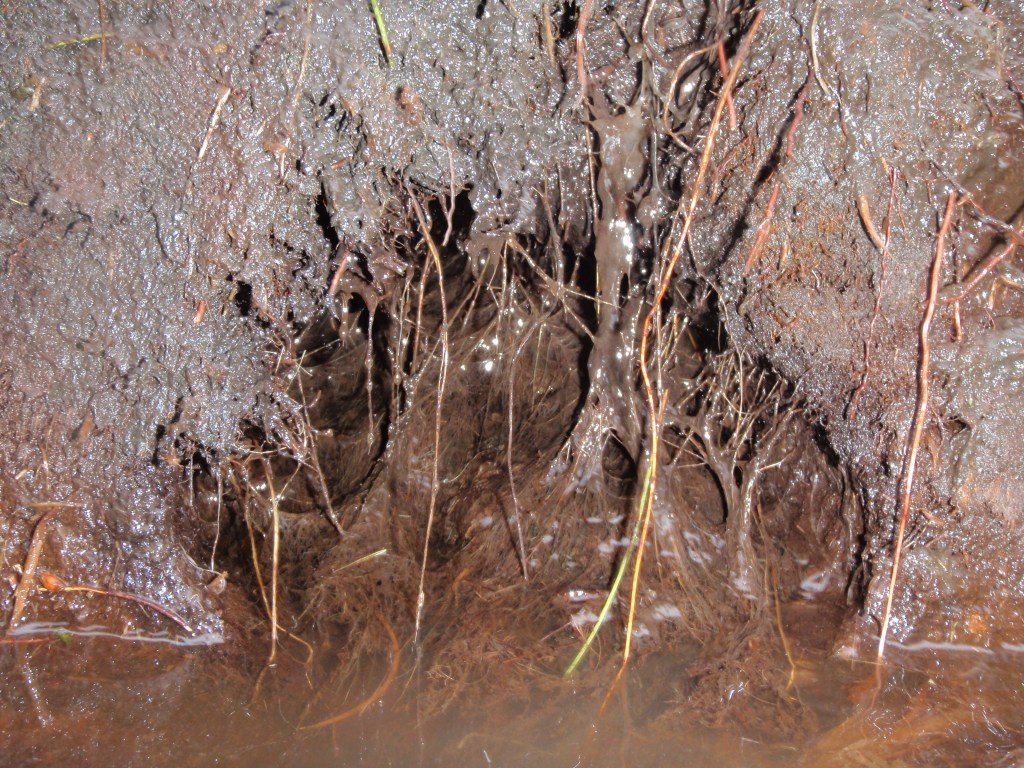
We found that the pipe itself was full of roots and that the hydraulic conductivity varied enormously between different samples of peat, and through the same sample when measured in different directions. The rates of water movement through the peat varied by over seven orders of magnitude (~10,000,000 times), illustrating the difficulty in deriving meaningful ‘average’ values of hydraulic conductivity. The pipe appeared to have been originally a surface stream that was buried by the formation of new peat over long periods. There are many more questions about the role of subsurface preferential flow paths in the formation and long-term (in)stability of blanket bog peatlands.
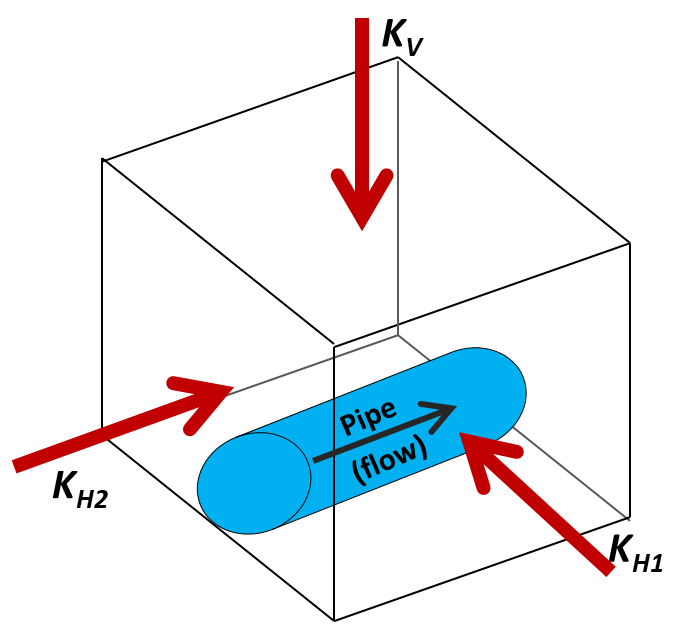
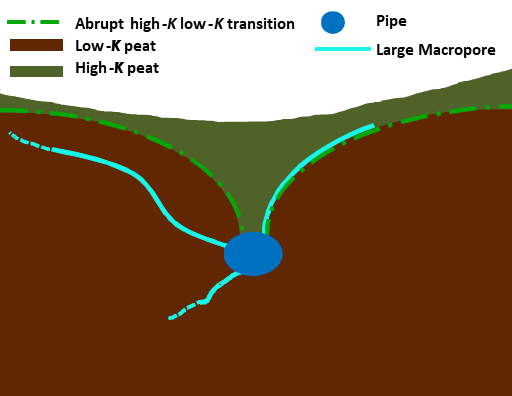
The full report is in Cunliffe, A., A. Baird and J. Holden, 2013, Hydrological hotspots in blanket peatlands: Spatial variation in peat permeability around a natural soil pipe, Water Resources Research 49(9):5342-5354. DOI:10.1002/wrcr.20435.
 Terrestrial Ecosystem Science & Services