
Safe Use of Drones in Ecology and Conservation
Dr Cunliffe has promoted the safe and effective use of unoccupied aerial systems (UAS, or drones) as a tool for ecology and conservation for over a decade. Drones provide a platform for deploying lightweight sensors in previously inaccessible locations, opening new avenues for scientific enquiry into natural phenomena and democratising remote sensing. However, they also come with challenges, which include regulatory complexities, quirks of keeping systems operational in challenging environments, and ensuring usable insights from the available data.
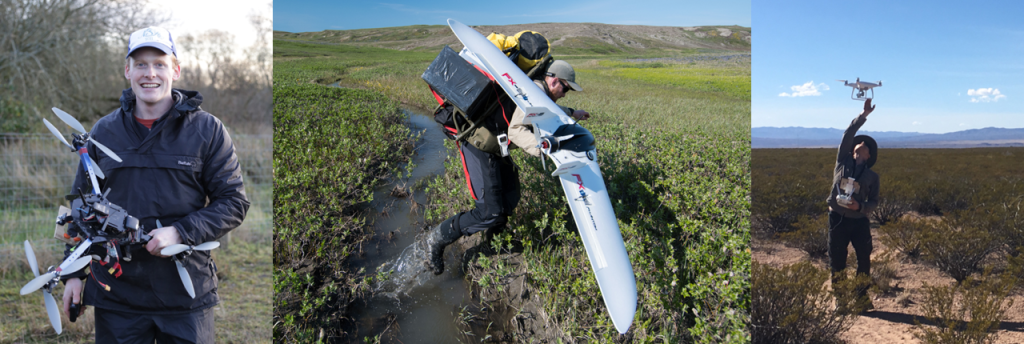
Our scholarly contributions with interdisciplinary collaborations have included (i) sharing best practices on deploying drones in challenging environments, (ii) publishing operation manuals to help other practitioners seeking formal accreditation for safe drone operations, and (iii) policy guidance to minimise the risk of social and environmental harms when using drones in biodiversity conservation that has been translated into four languages. We are proud of our efforts to promote better practice in this area and are always happy to explore new collaborations and initiatives in this space.

Experience and Qualifications
Dr Cunliffe has extensive experience deploying UAS as remote sensing tools. This includes piloting 18 multirotor and fixed-wing platforms on >1200 missions with a further > 500 flights as observer/payload operator, using mainly optical sensors to survey environments (e.g., coastlines, deserts, Arctic tundra, and tropical rainforests) spanning four continents. Encompassing all aspects of UAS including system selection, construction and maintenance, certification and regulation, flight operation, data acquisition, processing and analysis pipelines, this was originally more hands-on and now increasingly focuses on training and coordinating others using UAS to advance scientific and conservation goals. Dr Cunliffe has authored over twenty peer-reviewed scientific articles using drones for environmental science applications, and obtained the following qualifications to support this work:
- Basic National Unmanned Aircraft System Certificate awarded by the European UAV Systems Centre (2016);
- Special Flight Operations Certificate awarded by Transport Canada (2016 and 2017);
- Permission for Commercial Operations (PfCO) granted by the UK Civil Aviation Authority to the University of Exeter’s DroneLab (from 2016-2020).
- Remote Pilot Certificate for Small Unmanned Aircraft System awarded by the U.S. Federal Aviation Administration (2018, 2020);
- Night Operations Training Certificate awarded by Rupprecht Drones (2018);
- eBee fixed wing survey drone training by KOREC (2023)
- Remotely Piloted Aircraft Certificate awarded by the Civil Aviation Authority of Botswana (2022, 2023)
Selected outputs on this theme
Millner, N., A. Cunliffe, A. Jackman, Y. Laumonier, E. Lunstrum, M. Mulero-Pazmany, J. Paneque-Galvez, C. Sandbrook, S. Wich (2023) Responsible drone use in biodiversity conservation: Guidelines for environmental and conservation organisations who use drones.
Millner, N., A. Cunliffe, M. Mulero-Pazmany, B. Newport, C. Sandbrook, S. Wich (2023), Exploring the opportunities and risks of aerial monitoring for biodiversity conservation, Global Social Challenges Journal 2(1):2-23. DOI: 10.1332/TIOK6806.
Jackman, A., N. Millner, A. Cunliffe, Y. Laumonier, E. Lunstrum, J. Paneque-Galvez, S. Wich (2023) Protecting people and wildlife from the potential harms of drone use in biodiversity conservation: Interdisciplinary dialogues, Global Social Challenges Journal 2(1):68-83. DOI: 10.1332/IMLH5791.
Duffy*, J., A. Cunliffe*, L. DeBell, C. Sandbrook, S. Wich, J. Shutler and I. Myers-Smith and K. Anderson (2018) Location, Location, Location: Considerations when using lightweight drones in challenging environments. Remote Sensing in Ecology and Conservation 4(1):7-19. DOI: 10.1002/rse2.58.
Cunliffe, A., J. Duffy, L. DeBell, and K. Anderson (2017). A UK Civil Aviation Authority (CAA)- approved operations manual for safe deployment for lightweight drones in research. International Journal of Remote Sensing 8-10:2737-2744. DOI: 10.1080/01431161.2017.1286059.
(see Outputs for a comprehensive list)
 Terrestrial Ecosystem Science & Services